

Introduction
Hemp fiber, derived from the stalk of the Cannabis sativa plant, is gaining attention as a sustainable bio-based material. It is a bast fiber obtained from the plant’s outer stalk, composed of long, strong strands that have been used for millennia in rope, textiles, and paper. What makes hemp fiber technically unique is its internal structure and chemical makeup, which confer remarkable strength, durability, and environmental benefits. Unlike synthetic fibers (e.g. polyester) that achieve high performance at the cost of heavy environmental impacts, natural fibers like hemp offer a balance of strong material properties with far lower ecological footprint mdpi.com. Below, we highlight the intrinsic structural and compositional features of hemp fiber – and explain why these attributes make hemp an attractive raw material (without focusing on specific end-products or industries).
Composition and Structure of Hemp Fiber
Hemp fiber is a lignocellulosic fiber primarily composed of cellulose, with smaller fractions of hemicellulose, lignin, pectin, and waxes. In the bast (outer) fibers of hemp, cellulose typically makes up 52–78% of the fiber by weight mdpi.com. This high cellulose content is a key reason for hemp’s excellent mechanical strength and flexibility, since cellulose forms the fibrous, crystalline framework of the cell walls. Hemicellulose accounts for about 14–22% of the fiber; it serves as a matrix that, along with pectin, binds the cellulose microfibrils together mdpi.com. Lignin in hemp fiber is relatively low (around 3–10% in bast fiber) mdpi.com, especially compared to wood fibers that often contain over 20% lignin sciencedirect.com. This low lignin content means hemp fibers are less stiff and easier to process (e.g. easier to pulp or chemically rett), while still maintaining strength from the cellulose. Finally, a small percentage of pectin (up to ~10%) holds these components together in the plant; part of fiber processing (retting) is aimed at removing pectin to free the cellulose bundles mdpi.commdpi.com.
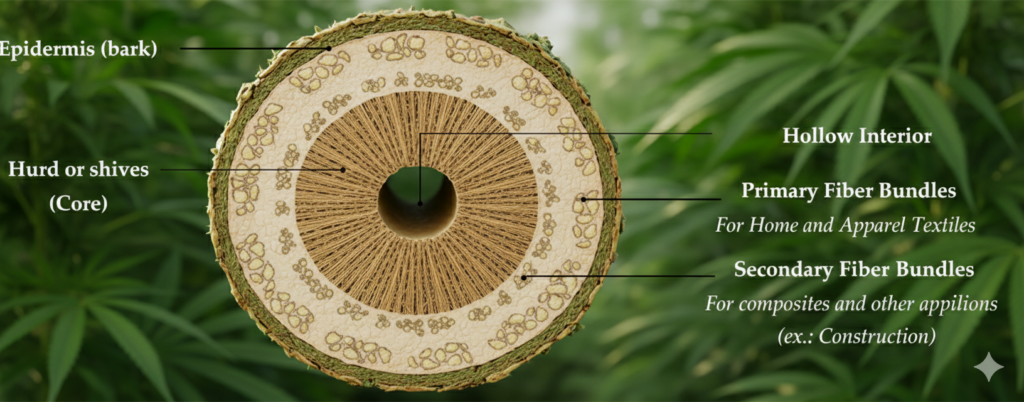
A cross-sectional view of an industrial hemp stalk, highlighting its distinct layers—epidermis, hurd (core), hollow interior, and primary and secondary fiber bundles—and their respective applications in textiles, composites, and construction.
Structurally, hemp bast fibers form in bundles running along the length of the stem, surrounding the woody core (hurd) mdpi.com. Each fiber is built in layers: a primary cell wall and a thicker secondary cell wall. The secondary cell wall is rich in aligned cellulose microfibrils (long chains of glucose molecules), typically containing 30–100 cellulose molecules per microfibril mdpi.com. These highly ordered microfibrils impart mechanical strength to the fiber, while the hemicellulose and lignin components fill the spaces between microfibrils, adding rigidity (lignin especially increases stiffness and resistance to degradation) mdpi.com. The net result is a lightweight yet strong fiber. Notably, the individual hemp fibers can be very long (often several feet in length in field conditions, far exceeding the length of cotton fibers). The long fiber length and bundle structure contribute to hemp’s toughness and also influence processing methods (long fibers require different spinning techniques than short fibers like cotton) mdpi.com. Overall, the makeup of compounds in hemp – predominantly cellulose reinforced by hemicellulose and lignin – produces a fiber with a high strength-to-weight ratio and good dimensional stability once processed.
Mechanical and Physical Properties
Thanks to its composition and structure, hemp fiber exhibits impressive mechanical properties among natural fibers. One of the most cited advantages is its tensile strength. Hemp’s tensile strength is significantly higher than that of cotton and many other plant fibersmdpi.com. For example, studies report hemp fibers can have tensile strength on the order of 500–900 MPa (megapascals), whereas cotton fibers are around 300–400 MPapmc.ncbi.nlm.nih.gov. In practical terms, hemp textiles and ropes can be 2–3 times stronger than comparable cotton products, reflecting the greater cellulose content and length of hemp fibersazom.com. This high tensile strength means hemp fibers and fabrics are more resistant to tearing and can withstand repeated stress. Hemp fiber also has a high Young’s modulus (stiffness), contributing to its durability in applications like composites and textiles where dimensional stability is important.
Another notable property of hemp fiber is its durability and longevity. Hemp’s high cellulose/low lignin makeup enhances its resistance to deformation and degradation: unlike cotton (which can weaken and wear out after many wash cycles), hemp fabrics tend to soften without losing strength and can last twice as long as cotton garments with proper care azom.com. The fibers are naturally resistant to rotting and UV light. In fact, hemp’s inherent UV resistance helps fabrics retain color and integrity over time, whereas cotton degrades faster under sunlightazom.comazom.com. Additionally, hemp fiber is anti-microbial and resists mold growth, owing to the presence of certain bioactive compounds and its porous structure. This means hemp textiles can remain odor-free and inhibit bacterial growth, a quality valued in applications like clothing or packaging liners.
The porous, hollow structure of hemp fibers also gives them excellent moisture absorbency and breathability. Hemp can absorb moisture up to 20% of its own weight while still feeling dry to the touch, and it wicks moisture away efficiently azom.com. This property, combined with the breathable fiber morphology, allows hemp materials to regulate temperature – keeping cool in warm conditions and insulating in cooler weather azom.com. At the same time, the lower lignin and wax content means the fibers dry faster and do not remain damp (which further prevents mildew). These physical traits (strength, durability, UV and microbial resistance, moisture management) all stem from hemp’s intrinsic material makeup and make it an attractive fiber for high-performance sustainable textiles and composites.
Environmental Sustainability of Hemp Fiber
In addition to its material performance, hemp stands out as a sustainable raw material due to how it is cultivated and its life-cycle characteristics. One major advantage is lower water requirements for growing hemp compared to other fiber crops. Peer-reviewed studies indicate that fiber hemp can require up to 70% less water than cotton to produce an equivalent yield link.springer.com. In practical terms, hemp might need on the order of 250–700 mm of water over a growing season, whereas cotton often requires over 700 mm (and in some regions 1,000+ mm) for a comparable season link.springer.commdpi.com. This means cultivating hemp fiber can dramatically reduce agricultural water consumption – a critical benefit in water-scarce regions. Farmers switching from traditional crops (like cotton or alfalfa) to hemp have observed significant water savings, helping meet water conservation goals. Moreover, hemp’s growth cycle is only about 3–4 months, so it reaches maturity faster and often before the driest part of the season.
From a carbon footprint perspective, hemp is a carbon-sequestering crop. It is estimated that one hectare of industrial hemp can absorb on the order of 9–15 tonnes of CO₂ from the atmosphere over its growth period agriculture.ec.europa.eu. This is comparable to the carbon sequestration of an entire young forest, achieved in just a single growing season. When hemp fiber is used in long-lived products (such as building materials or durable goods), that carbon remains stored for the life of the product, contributing to carbon-negative material solutions. Even when disposed, hemp is biodegradable, meaning it can break down naturally without persistent pollution (unlike synthetic fibers which create microplastics). These environmental attributes – low water use, minimal agro-chemicals, carbon capture, and biodegradability – underscore why hemp is often promoted as a sustainable, bio-based solution in materials science and industry.
Conclusion
Hemp fiber’s technical profile is defined by a high-cellulose, low-lignin composition organized into long, strong fiber bundles. This gives hemp an outstanding combination of strength, durability, and functional properties (like moisture and UV resistance) that surpass many other natural fibers. Crucially, these benefits come alongside significant sustainability advantages in cultivation and end-of-life. Hemp requires far less water and chemicals to grow than conventional fiber crops, and it actively improves environmental outcomes by sequestering carbon and enriching soil. These facts highlight why hemp is valued as a raw material: not because of hype or any single application, but because its intrinsic makeup and structure provide a foundation for high-performance and eco-friendly materials. By focusing on these core technical aspects of hemp fiber, one can appreciate its potential to advance sustainable material innovation purely from the standpoint of what the fiber is, rather than just what products it can make.
Sources:
- Mariz, J. et al. (2023). Hemp: From Field to Fiber—A Review. Textiles, 4(2), 332–368. (Contains comprehensive data on hemp fiber composition, properties, and environmental factors) mdpi.commdpi.com.
- Matthews, S. et al. (2023). The potential of industrial hemp as a drought-resistant fiber crop. Plant and Soil. (Reports that hemp requires ~70% less water than cotton for fiber production) link.springer.com.
- European Commission – Agriculture and Rural Development. Hemp (2023). (Highlights environmental benefits of hemp cultivation, including carbon sequestration and low pesticide use) agriculture.ec.europa.euagriculture.ec.europa.eu.
- AZoM Materials. Is Hemp Fabric Better Than Cotton? (2023). (Discusses hemp vs cotton fiber content and durability) azom.comazom.com.
- Celignis Analytical. Composition of Hemp Biomass. (2021). (Notes typical cellulose and lignin content in hemp bast vs wood) sciencedirect.com.