
Last week the global industrial hemp community gathered in Poznań, Poland, for the 23rd Annual European Industrial Hemp Association (EIHA) Conference — the first time the event has ever been held in Poland. IND HEMP made the trip, both as an exhibitor and with two of our team speaking on panels, and we came home with a notebook full of contacts, ideas, and a renewed sense of where this industry is headed.
This year’s gathering was hosted in partnership with the Institute of Natural Fibres and Medicinal Plants (IWNiRZ) — a research institution that has been advancing botanical and fiber science since 1930. Holding the conference inside a working research institute set the tone for the entire event. This was not a room full of slides and projections about what hemp could do someday. As EIHA framed it, the goal this year was to move the conversation “from potential to performance.” That shift was felt in every session.
A genuinely global room
What struck us first was the turnout. Roughly 250 decision-makers from across the value chain filled the venue — farmers, processors, manufacturers, researchers, policymakers, and investors — and they came from all over the world. In the span of a single afternoon you could hear from a Ukrainian fiber processor, a Chinese textile manufacturer, a Swedish insulation company, an Argentine producer, and a French growers’ association — each working a different corner of the same plant, all under one roof. Companies and individuals from dozens of countries, comparing notes on problems that turned out to rhyme more than anyone expected.
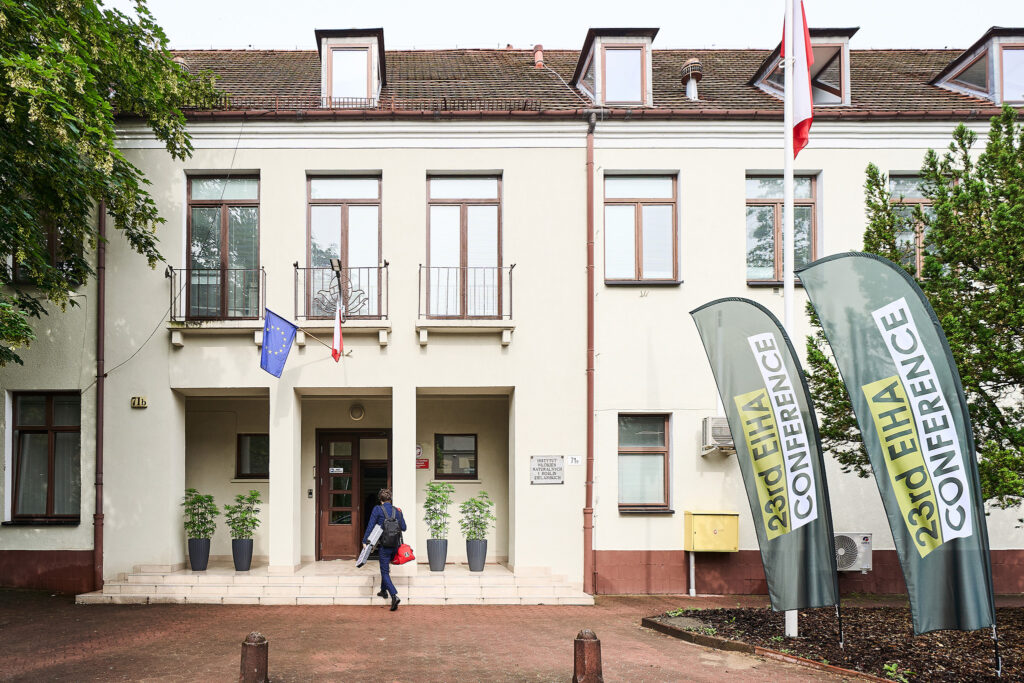
The program reflected that breadth. Dedicated technical tracks covered composites, textiles, construction, food, feed, and cosmetics, alongside the policy and market sessions that anchor an EIHA conference. Lab visits at IWNiRZ and side tours to a stalk-processing facility and a seed-multiplication farm — complete with an autonomous robotic farming demonstration — kept the whole event grounded in real, working infrastructure rather than theory.
IND HEMP on the program
We were proud to have two voices on the program this year.
Ken Elliott, IND HEMP’s founder and president, joined the panel “Global Hemp Markets: Europe in the International Landscape,” moderated by NIHC and Bio-Smart Group ambassador Morris Beegle. It was a fitting room for Ken: a comparative look at how hemp markets are developing around the world — regulatory frameworks, investment trends, data, and industrial applications — with the explicit aim of situating Europe within the global competitive picture. Alongside Ken were Maximiliano Baranoff of IHS Grupo (Argentina), Rick Fox of FIHO, Jérôme Gallois of Interchanvre (France), and Beau Whitney, chief economist at Whitney Economics. Ken built IND HEMP from the ground up in Fort Benton, Montana, and brought the perspective of an operator who has actually stood up fiber and grain processing at scale in North America — a concrete, performance-over-potential data point in a conversation that otherwise spanned four continents.
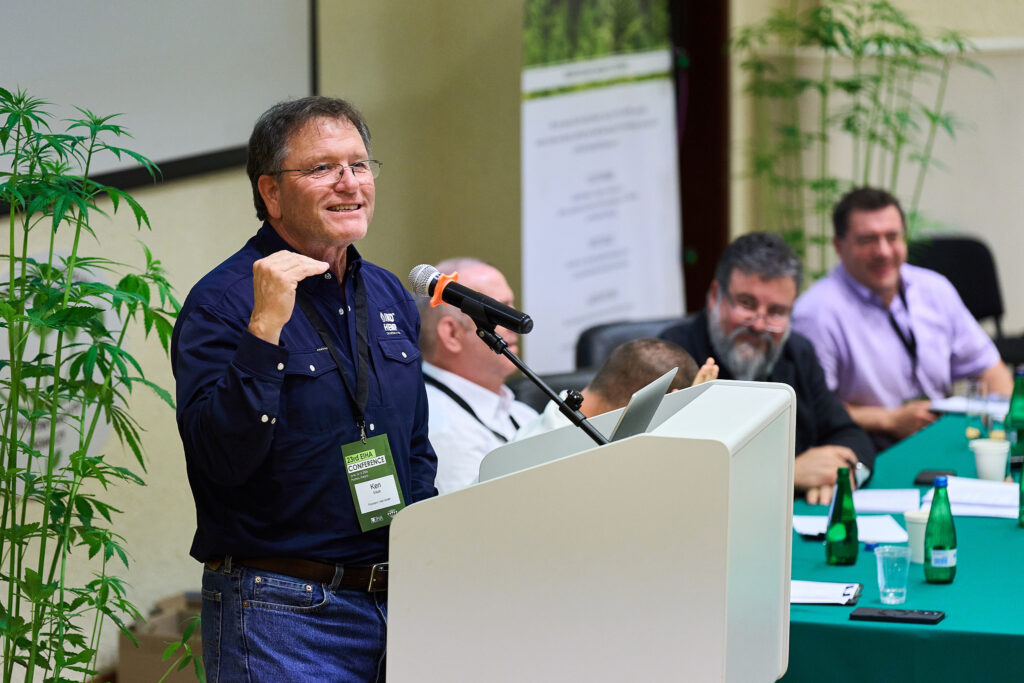
Ken Elliott,
IND HEMP, Owner and co-founder
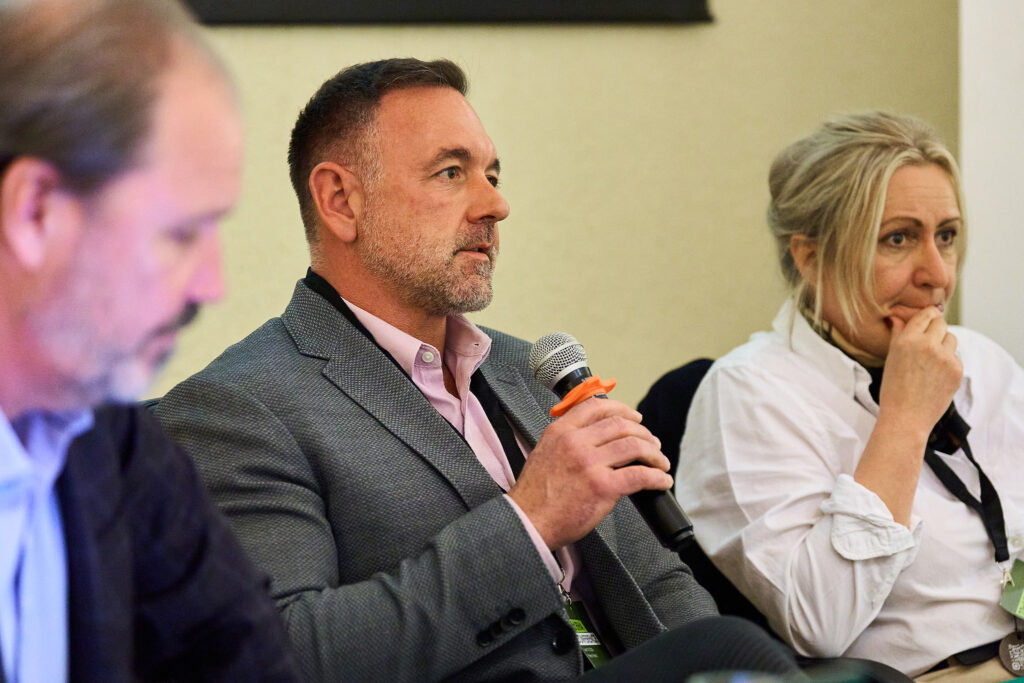
Rusty Peterson,
IND HEMP, Director of Carbon & Strategic Initiatives
Rusty Peterson, our Director of Carbon & Strategic Initiatives, joined the panel “Measuring Impact: Hemp and Carbon Sequestration,” moderated by independent consultant Robert Hoban and shared with Collin Steddy, Director of Hemp Inside (Australia), and Catherine Wilson, CEO of HIP Services. The session brought industry and research voices together to assess methodologies, data gaps, and how hemp can credibly position itself within carbon markets and sustainability frameworks.
Rusty’s core argument was simple to state and hard to do: in carbon, measurement is the moat. The hemp sector has a habit of compressing very different things into a single headline number, and that overclaiming is exactly what erodes credibility with serious buyers. His contribution was to keep three distinct carbon pools clearly separated rather than conflated — the transient carbon a growing crop pulls from the air, the durable carbon stored in soil, and the carbon locked into long-lived products. Each is real; each is measured differently; and the discipline of keeping them apart is what makes a claim defensible.
That framing connected directly to the work IND HEMP and our IH Carbon business unit are building: a soil organic carbon project in Montana under Verra’s VM0042 methodology, cradle-to-gate life-cycle assessments feeding our partners’ Environmental Product Declarations, and an emerging biochar pathway that turns hemp residue into durable carbon removal. It also landed squarely in the moment — with the EU’s Carbon Removal and Carbon Farming framework now in force, the European market is being built to fund exactly the kind of rigorously measured pathways the panel was debating.
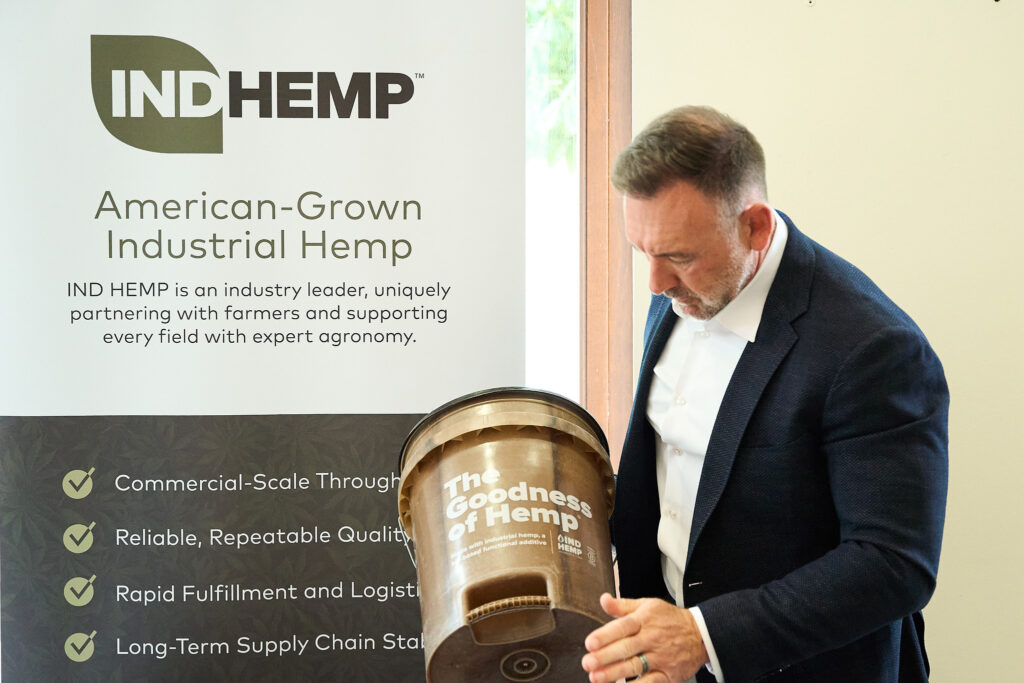
Voices from across the value chain
The presentations made that global character concrete, and a few stuck with us.
From Ukraine, Andriy Mykytiv of Ma’Rijany Hemp Company walked through an integrated long-fiber operation in the Zhytomyr region — breeding and multiplying seed, cultivating, scutching, and now spinning its own yarn, with a new processing line that only came online in 2025. He was clear-eyed about the market reality, too: long hemp fiber still lives “in the shadow of flax,” competing less on fiber properties than against flax’s larger, older, fully optimized industrial ecosystem. What none of us will forget is the candor of his slide on operating through war — capital constraints, staff being called to the draft, four months of stopped production during blackouts, the permanent risk of losing the asset entirely — followed by a single line: they want to build it in Ukraine anyway. It was the most quietly powerful moment of the conference.
From China, Hongliang Ding of Hemp Fortex set the long view, tracing more than six thousand years of Chinese hemp textile heritage before laying out a thoroughly modern, vertically integrated operation running from cultivation through yarn, fabric, and finished garments. The technical heart of the talk was degumming — mechanical, enzyme, and chemical routes that yield progressively finer fiber for everything from industrial textiles to high-end fashion — alongside wet spinning capable of 100% hemp yarns and a hemp-based lyocell. It was a clear reminder of the depth of processing know-how that already exists in the sector.
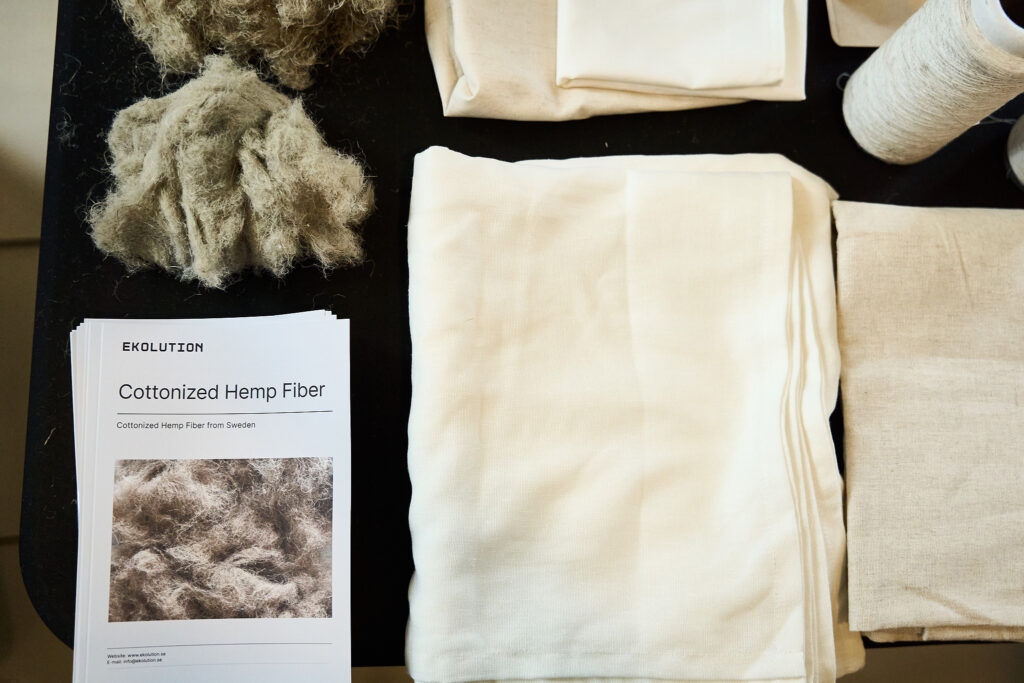
From Sweden, Remi Lorén of Ekolution gave a talk whose title could have been the conference’s: “from establishment to industrialization.” Ekolution has scaled cultivation dramatically and runs a vertically integrated line producing carbon-negative hemp insulation with a published EPD — and is expanding from that core into textiles, acoustics, and façade applications. The detail that resonated most with us was strategic: Ekolution treats the data generated at every step of its integrated value chain as a competitive moat in its own right. That is, almost word for word, the thesis Rusty carried into the carbon panel — that in this industry, rigorous measurement is the differentiator.
And from S.Lab (also rooted in Ukraine), a glimpse of where hemp goes next: protective packaging grown from hemp shives and mushroom mycelium, home-compostable and positioned as a direct replacement for polystyrene. The proof of demand was the logo wall — global brands across beauty, electronics, and consumer goods already piloting the material. It’s a vivid example of the downstream pull that, ultimately, is what makes upstream hemp economics work.
Put those four side by side — Ukraine, China, Sweden, and a packaging innovator bridging fields and global supply chains — and a pattern jumps out. Independently, on different continents, operators are converging on the same playbook: integrate the value chain, industrialize, and measure your impact rigorously enough to prove it. That convergence is exactly why a room like this matters.
What we took home
If there was a single thread running through Poznań, it was the alignment between research and industry — the sense that the science and the businesses are finally pulling in the same direction. The technical depth in the room was real, and so was the appetite to put it to work.
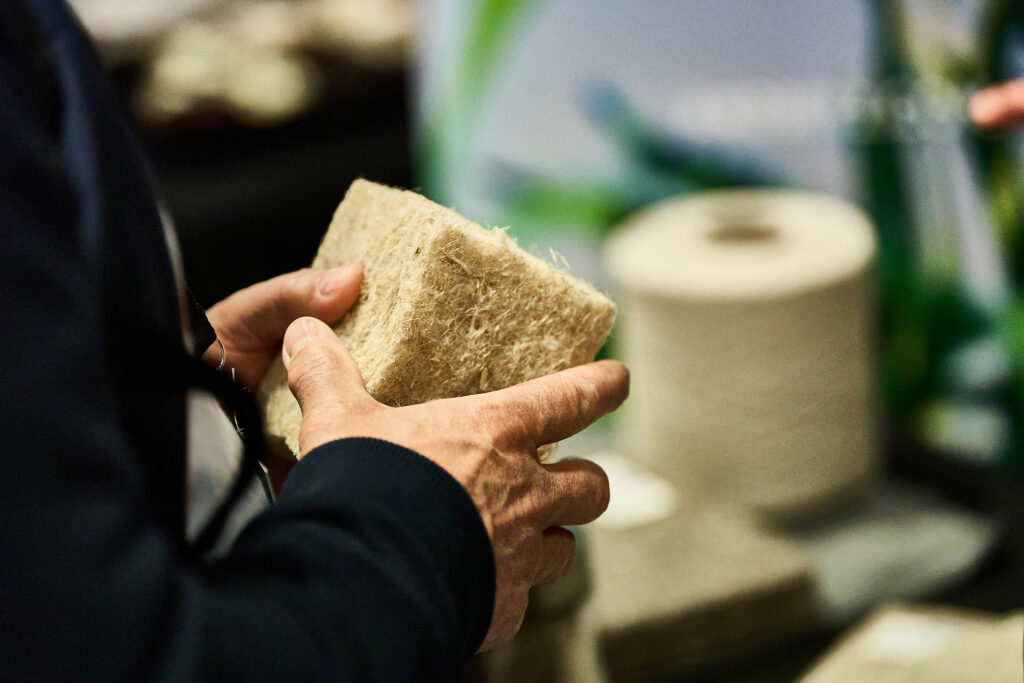
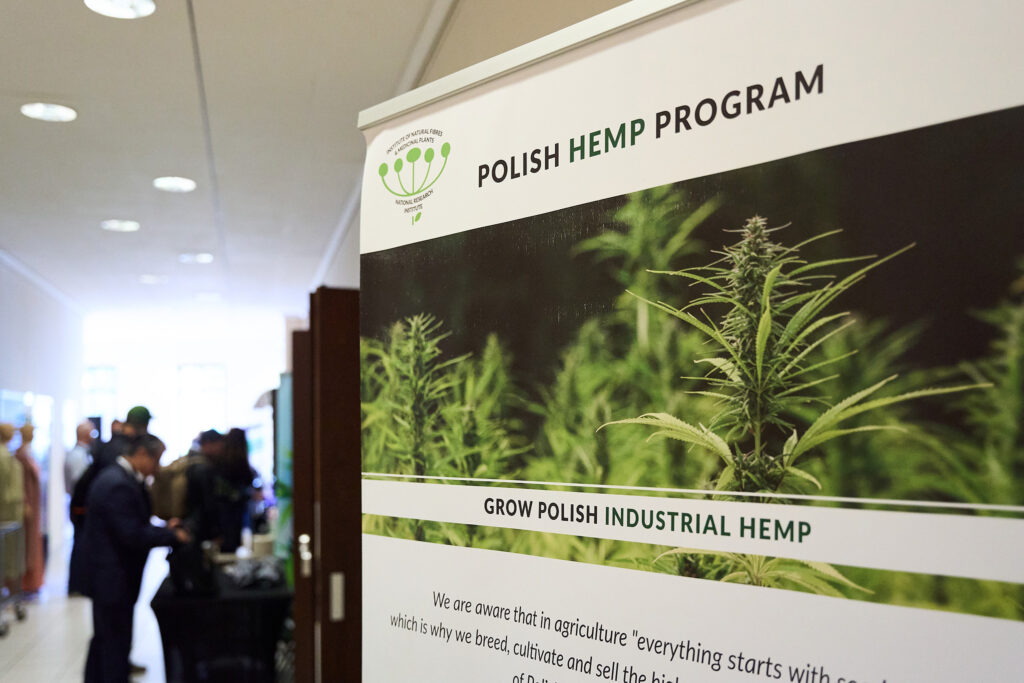
But the thing that resonated most for us wasn’t in any one presentation. It was the feeling that ran underneath all of them. For an industry that is still, by any honest measure, early in its growth, there was remarkably little posturing and a great deal of genuine collaboration. People who compete in some markets were openly comparing notes in others. Researchers handed working data to operators. Companies from opposite sides of the planet found that their problems — and their solutions — rhymed.
That is the part worth holding onto. Industrial hemp does not scale because any one company, or any one country, cracks it alone. It scales because a global community decides to raise the whole space together. Poznań was a reminder that this community exists, that it is growing, and that it is increasingly serious about performance over promises.
Our thanks to EIHA and IWNiRZ for hosting, to our fellow panelists and the colleagues we met along the way, and to everyone who stopped by to talk. We left more convinced than ever that the best work in this industry happens shoulder to shoulder.
See you at the next one.